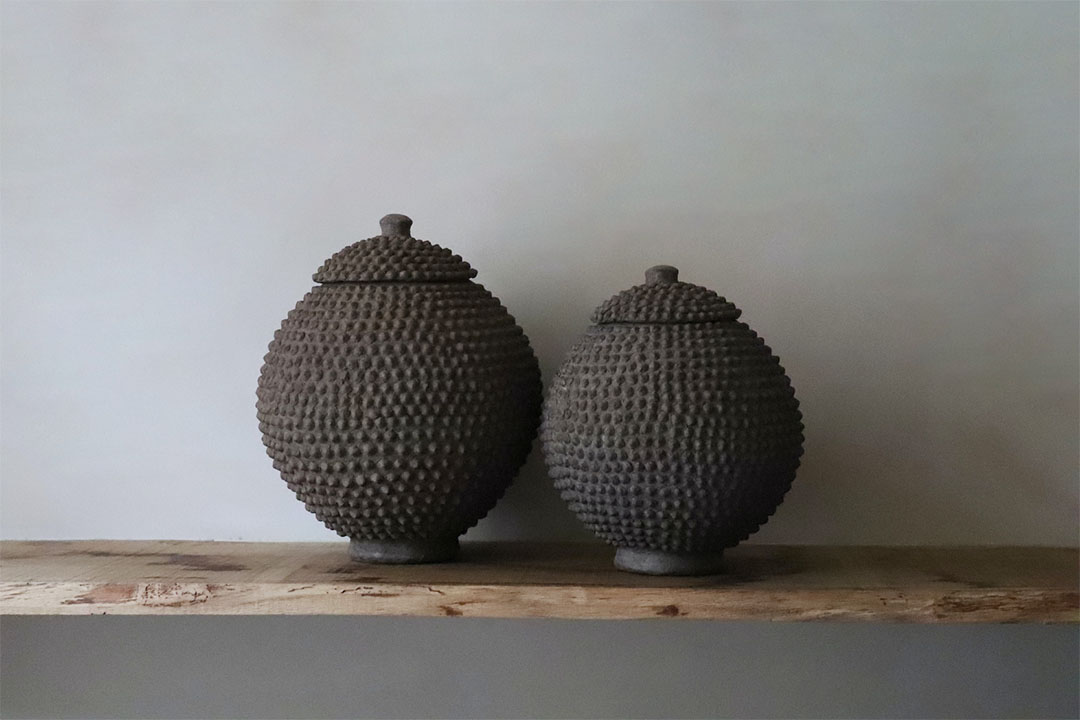
These vessels, made by the Lobi people of Burkina Faso (some also live in northern Ghana and Côte d’Ivoire), are not made for domestic utilitarian use. Such pots are unadorned. Instead, such vessels are intended as a homestead altar.
Pottery is found on many altars and is often specially made to be placed there. Only potters who have reached menopause make altar vessels, for it is believed that a woman who does so during her childbearing years risks becoming barren. Moreover, this is the work of only the most masterful practitioners, who are recognised for their skill and understanding of the esoteric rules that govern supernatural interactions. (Berzock 2005, 73, citing Schneider 1990)
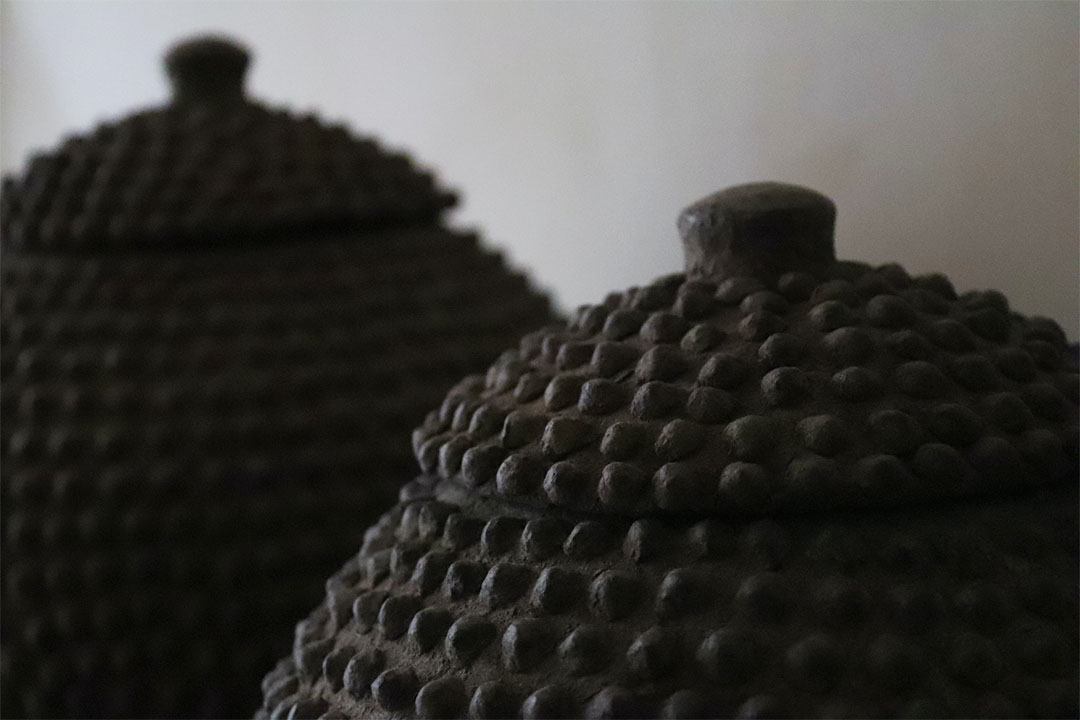
These vessels, like all traditional African pottery, are hand built. The Lobi use a combination of pressing out a mass of clay to start the vessel and then adding rolls of clay that are smoothed out to make the walls. The dried vessels are then fired in an open firing without a pit, using firewood as fuel. The spiky bumps covering the surface symbolise both protection against witchcraft, misfortune, and illness and the hope for fecundity and fertility (Schneider 1990).
These vessels, made by the Lobi people of Burkina Faso (some also live in northern Ghana and Côte d’Ivoire), are not made for domestic utilitarian use. Such pots are unadorned. Instead, such vessels are intended as a homestead altar.
Pottery is found on many altars and is often specially made to be placed there. Only potters who have reached menopause make altar vessels, for it is believed that a woman who does so during her childbearing years risks becoming barren. Moreover, this is the work of only the most masterful practitioners, who are recognised for their skill and understanding of the esoteric rules that govern supernatural interactions. (Berzock 2005, 73, citing Schneider 1990)
These vessels, like all traditional African pottery, are hand built. The Lobi use a combination of pressing out a mass of clay to start the vessel and then adding rolls of clay that are smoothed out to make the walls. The dried vessels are then fired in an open firing without a pit, using firewood as fuel. The spiky bumps covering the surface symbolise both protection against witchcraft, misfortune, and illness and the hope for fecundity and fertility (Schneider 1990).
|
38 H x 29 d cm 30 H x 24 d cm |